Tenure hall
Renting against owning
The argument that rent is dead money and a mortgage is not is too crude to be useful. Both tenures contain money that never comes back. The honest comparison is between the two sets of unrecoverable costs, plus everything that is not money.
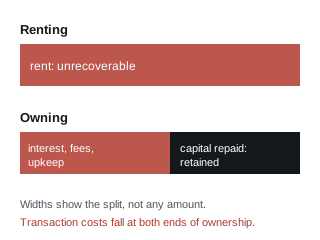
Unrecoverable costs on both sides
Renting: the rent itself, in full. That is the whole of it, plus whatever contents insurance and moving costs the household chooses.
Owning: the interest portion of the mortgage payment, which is a payment for the use of money in just the way rent is a payment for the use of a building; transaction costs on buying and later on selling, which are substantial and are incurred twice; maintenance, insurance and any charges; and the return foregone on the capital tied up in the deposit.
The repayment portion of the mortgage is the exception. It converts income into equity rather than consuming it, which is the real financial difference between the tenures — not the absence of cost, but the presence of a savings component embedded in a monthly obligation.
What time does to the comparison
Buying carries a large cost at both ends and a smaller cost in the middle; renting carries an even cost throughout. The longer the period of occupation, the more the fixed transaction costs are spread, and the more likely ownership is to compare favourably on cash alone. Over short horizons the transaction costs dominate and often exceed anything the household could reasonably expect to gain.
This is why the same household can be right to rent at one stage of life and right to buy at another without either decision being a mistake. The variable that changed was the expected length of stay.
What is not money
Owning buys control: the right to alter, decorate, keep an animal, and stay as long as the payments are made. It also buys the liability for everything that breaks. Renting buys mobility and transfers structural risk to someone else, at the cost of security of tenure and of any say over what the property is like.
For many households these non-financial differences are decisive and no arithmetic will overturn them. A household that expects to move for work within a couple of years, or that cannot absorb an unexpected roof, is making a sound decision to rent even where the sums appear to favour buying.
The risk that runs both ways
An owner is exposed to the value of one asset in one street, which is the opposite of a diversified position, and is exposed to interest rates at the end of every fixed period. A renter is exposed to the rental market and to the possibility of having to move at someone else's convenience. Neither tenure removes housing risk; they allocate it differently.
How to think about it without a spreadsheet
Ask three questions. How long, realistically, will this household stay in this place? How much disruption would an unexpected large repair cause, or an unexpected required move? And what does the household want the next few years to be shaped around? The financial answer is rarely so lopsided that it can overrule the answers to those.