Place hall
Reading a street on the first walk
Most of what determines whether a street will suit a household is visible from the pavement, and almost none of it is in the listing. This is a guide to looking.
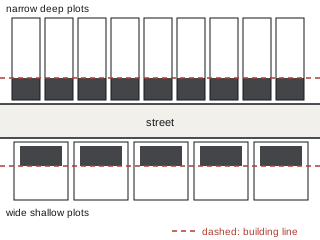
Grain: plot width and depth
The width of a plot at the street and the depth behind it are the two numbers that shape everything else. Narrow deep plots produce terraces and long gardens; wide shallow plots produce detached and semi-detached housing with room at the side. Grain is remarkably persistent: it usually survives the buildings that sat on it, which is why a street can be rebuilt and still feel the same age.
The building line
How far the fronts sit back from the pavement, and whether they all sit back by the same amount. A consistent line means a street laid out at once, to a plan. An irregular line means a street that filled in over time, plot by plot. The second kind almost always contains more variety in size, condition and price than the first.
Front boundaries
Walls, railings, hedges, or nothing at all. Original low front walls with the remains of railings suggest one period; open frontage with hard standing suggests a later adaptation for cars. Where half a street has converted its front gardens and half has not, you are looking at a slow argument about parking that will continue after any new household arrives.
Roofs and their ages
Roof coverings age visibly and unevenly. A street where every roof has been replaced at a different time indicates individual ownership over decades; where they have all been replaced together, some collective or institutional owner has been at work. Dormers, rooflights and altered ridgelines tell you which houses have already converted their loft and therefore what the plan of your own is likely to be.
Extensions and their pattern
Look at the rear from the ends of the street or from any open ground. If most houses have already been extended in one particular way, that is a strong indication of what the plot geometry permits and what precedent has been established. If none have, it may indicate a constraint worth asking about.
Trees
Street trees are a good clock. Their species and girth indicate roughly when the street was laid out or last replanted, and their presence indicates a long period of maintained public spending. Large mature trees near buildings are also a practical matter for foundations and drains, which is something a survey will raise if it is relevant.
Parking pressure
Count cars, not spaces, and do it at three times: mid-morning, early evening, and at the weekend. Parking pressure is the most common source of daily friction in residential streets and the easiest thing to misjudge from a single afternoon viewing.
Sound and light
Stand still and listen for a full minute. Traffic on a road one street away, a school at closing time, a railway line behind a fence, extraction fans from commercial premises: all are entirely absent from photographs. Note which way the street faces and where the sun will be at the times the household is actually at home, which for most people is early morning and evening.
The edges
Walk to both ends. Streets are usually described by their middles and experienced through their edges: what the street runs into, how far the nearest shops are on foot, whether the route to the station passes anywhere unpleasant after dark, and what sits on the other side of the back fence.